Parents: supporting children with SEND during home-based learning. 5 tips to support reading, writing, routines.

I’m a teacher. It can be really hard getting pupils to work consistently well, to the level where they make great progress.

I’m a parent. It can be really, really hard getting your child to work consistently well, to the level where they can make some progress.

Both these statements are true whether or not a child has a Special Educational Need or Disability.

I’ve put 5 quick tips below for supporting your child with routines, the development of reading and the development of their writing while they are at home with you. Some of the tips are about working closely with them; others are about promoting independence where possible. I think there is something in them for both primary and secondary. They are aimed at children with SEND but I hope will be appropriate for many, regardless of SEND status. I hope there is a flicker of something in what I’m suggesting that is useful for every parent and carer at the moment. Links at the bottom of the page.

Routines:

1. Set a timetable with your child. Review this every week or two – it will get stale and need refreshing. Listen to your child on what needs changing. Show sympathy but know what your non-negotiables are also.

2. Agree something with your child about mobile phone use. Try to trust them to have it in the room if they need to; the proof is in the work they produce.

3. Don’t expect perfection.

4. Start each day by going through what needs to be done. Don’t be militant if your child is working hard but doesn’t complete everything they aim to.

5. Try to support autonomy wherever possible. Allow your child to consider how they produce a piece of work, when a break is appropriate, etc.

Tips to support reading:

Consider whether the purpose of the task is to develop reading or to access curriculum content.

If the purpose of the task is the development of reading, you may help by:

  1. Insist on 10-15 minutes of reading per day. This reading should be out loud to an adult. It will hopefully be from a book the child is motivated to read. Make it quality, distraction-free time between you and your child as much as possible.
  2. Use the super skills for reciprocal reading (predicting, clarifying, questioning, summarising).

If the purpose of the task is to access curriculum content, you may help by:

  1. Reading the text (i.e. the instructions, the source, the pages of the textbook) for your child.
  2. Download the App ‘Seeing AI’. Your child will be able to hover over a piece of text from a screen or a book; the App will read it aloud for them.
  3. On Microsoft Edge, use the book icon in the URL to see options for making a website more accessible (text-to-speech, coloured background, etc). On Microsoft Word, you can change the colour of the page on the Display tab (page colour) to make reading easier. You can also highlight text and it will read it aloud for you.

Tips to support writing

  1. Try to understand the quality of your child’s writing when they’re at school, by looking at their school books or speaking to their class teacher. Make sure you know the level of difficulty versus the level of reluctance.
  2. Discuss the child’s work with them. Make some notes while you are both talking. Leave your child with those notes to help them to scaffold their writing.
  3. Put a small mark in your child’s book. Let them know that, by the time you check again, they should have reached your mark with their writing. Having small, achievable goals like this can really help reluctant writers.
  4. When looking at your child’s writing, focus first on the positives. Where improvements are possible (handwriting, spelling, grammar) don’t ignore the things you can praise first. As soon as you recognise improvements in these things, show that you have noticed.
  5. Consider whether typing or handwriting is the most helpful thing. Typingclub.com offers a free touch typing programme if that could help to develop typing fluency. On the newest versions of Word, there is a ‘Dictate’ button to allow speech-to-text.

Reciprocal reading strategies

https://www.readingrockets.org/strategies/reciprocal_teaching

Seeing AI

https://apps.apple.com/gb/app/seeing-ai/id999062298

Typing club

www.typingclub.com

Spellzone

www.spellzone.com

Accessibility in Microsoft Word

https://www.microsoft.com/en-gb/Accessibility/office

Accessibility in Internet Explorer

https://support.microsoft.com/en-us/help/17456/windows-internet-explorer-ease-of-access-options

Accessibility in Google Chrome

https://chrome.google.com/webstore/detail/text-to-speech/hmmfmpjefnijeadpgbfjgcmicfeddfoj

How to ensure effective parent-school partnership when schools reopen

In the last blogpost, I mentioned some of the literature that shows fairly definitively that parent/carer involvement is a highly significant factor in children making progress in school. I pointed to some of the research that shows it being particularly true for children with special educational needs and disabilities. What does best practice look like for parental partnership? With a unique transition from home to school this year following the impact of coronavirus, what will good practice look like from SENDCOs interested in outstanding parental partnership?

We now know that transition will begin for some after May half-term . There is some excellent material being written about managing this transition back to school for pupils with SEND, such as from Natalie Packer and Lynn McCann. They rightly consider the vital question of how to support children in their return. But what of the parents? If we know their involvement is key, how do we prepare them to be active partners in their child’s return to school, in such a potentially anxious time for parents?

To consider what good practice in this context looks like, it is important to know what good practice looks like under normal conditions.

Outstanding parent partnership under normal circumstances

  1. Ensure the basics of communication are done well – parents must know who they should contact and how they should contact them. They require written communication about targets, interventions and progress. Taking a whole-school approach (DfE-00205-2013), communication must come from the wider school staff, not merely the SEND team.
  2. Move beyond three times per year – have a frequently open door, with opportunities for parents to meet the SENDCo at least 6 times per year. This will be a combination of 1-to-1 meetings and more informal, group meetings or coffee mornings. Be wary of reducing communication when children are in secondary school, as typically occurs (Povey et al, 2016) when children leave primary school. Consider on a case-by-case basis which parents need a regular phone call or chance to meet, above and beyond what other parents require.
  3. Educate and support parents – provide sessions for parents about the school curriculum and about their child’s SEND (Kreider et al, 2007). This should include opportunities for the parents to network with one another, sharing their experiences. Consider parents’ feelings here, which may (but may not) be negative towards their child’s SEND (CACE, 1967). Communication with parents, particularly around the beginning of a process that involves the child going on the SEND register, should be particularly thoughtful and conducted in person where possible.
  4. Use parents – Interventions can be further supported at home. Whenever parents are being informed about an intervention or target, be explicit with ideas about how this might be supported at home. Get parental input on the advice that is given to all teachers about meeting their child’s need, bringing them in in some cases to meet with the child’s teachers. Use parents’ knowledge of the child to help the school to understand them more fully and to better meet need (DFEE 1994a, 2:28).
  5. Co-produce with parents – Consult with parents when changes are being proposed to provision, and learn from them about whether they believe changes should be made (Lindsay et al, 2016). This may involve establishing an SEND parent group that meets regularly, as well as having SEND parent representation at the school and/or MAT Governors’ level.

The principles of good parent partnership aren’t abandoned because of school closure and the eventual return to the school building. However, there are nuances to what these principles look like in practice, which are worth considering.

Outstanding parent partnership as schools reopen

  1. Be clear and be neutral

Make sure the plan to keep children as safe as possible in school (hand washing, class sizes, etc) is put into writing. Let parents have this and reference it often.

Be neutral where possible about your school’s and/or the Government’s decisions around reopening. Show that you are the person enacting the decision and helping it to happen as safely as possible, rather than the person responsible for national policy. Keep personal opinions for your Headteacher (and if necessary the unions!)

2. Be communicative

Review your normal communication with parents. It will need increasing dramatically for the majority of schools. Consider how to do this in a realistic manner:

A group text or email about the day, to a large group of parents (i.e. of children with SEND or all parents)

Putting slots on your own calendar that you dedicate for meeting with parents (i.e. 5 x 20 minute slots per week). Make these slots known to parents. Parents will take comfort from the opportunity even if they don’t take it up. It will help them to know that your door is open.

Praise praise praise. Ask everybody everyday which child did something praise-worthy. Use your school systems (postcards, merits, certificates) to go heavy on the praise. Make sure these school systems allow parents to see this praise.

3. Be supportive

Allow opportunities for peer support. It may be appropriate to hold some kind of coffee morning for parents (in person or online), or to use an engaged parent to set up a WhatsApp group independent of the school.

Identify a small number of parents who need much closer (i.e. daily) contact from school. Consider how this might be shared for different children, i.e. between colleagues, the child’s class teacher, etc.

Ask your parents what support they need. Offer appropriate sessions, either via resources going home, an online meeting or in person, as appropriate. These might be on wellbeing, managing behaviour, managing stress, personal wellbeing (i.e. the wellbeing of the parent).

4. Be appreciative

It will feel like more of a risk than normal sending their child to school. When the time comes, and without putting undue pressure on parents, acknowledge this with a thank you.

5. Be balanced

Continue your systems for those not able to attend: year groups not yet invited back; the medically vulnerable; etc.

The principles remain but the actions need some nuance. With a nuanced approach based on a sound and supportive set of principles, parents and carers can feel an empowered, involved and reassured part of the transition process.

References

Department for Education/Department of Health. 2015. Special educational needs and disability code of practice: 0-25 years. DFE-00205-2013.

Department for Education and Employment. 1994. Code of Practice on the Identification and Assessment of Special Educational Needs.

Kreider, Holly; Margaret, Caspe; Kennedy, Susan; Weiss, Heather. 2007. Family Involvement in Middle and High School Students’ Education. Involvement Makes a Difference: Evidence that Family Involvement Promotes School Success for Every Child of Every Age. Harvard Family Research Project. Volume 3.

Lindsay, G., Ricketts, J., Peacey, L. V., Dockrell, J. E., & Charman, T. 2016.. Meeting the educational and social needs of children with language impairment or autism spectrum disorder: the parents’ perspectives. International Journal of Language & Communication Disorders. Volume 51, Issue 5.

Plowden, B. 1967. Children and their Primary Schools. London: A report of the Central Advisory Council for Education.

Povey, Jenny, Campbell, Alice Kate, Willis, Linda-Dianne, Haynes, Michele, Western, Mark, Bennett, Sarah, Antrobus, Emma and Pedde, Charley. 2016. Engaging parents in schools and building parent-school partnerships: The role of school and parent organisation leadership. International Journal of Educational Research. Volume 79.

Time to get school-parent partnership right for children with SEND

It’s really time to get school-parent partnership right. If we hadn’t realised already that parents and carers are the vital cog in the wheel of successful provision for children with special educational needs, school closure should be a timely reminder of the need for a truly partnered approach for any school that prides itself on successful inclusion.

Schools are now totally reliant on parents to ensure children receive any kind of education. Parents are no longer the poor relation, the after-thought. They are the teacher, the motivator, the problem solver. As well as the parent. And in many cases, the person trying to balance parenting with working from home with trying to decipher curriculum content.

For a SENDCO, good communication with parents and carers is vital if a school considers itself to have an excellent provision for children with SEND. But schools have been closed since March 20th. What lessons can be learned from school closure in terms of communicating with parents of children with SEND?

Effective parent partnership is essential

Parental involvement is positively associated with achievement (Hill and Tyson, 2009), socioemotional development (Kreider et al, 2007), behaviour in school (Powell et al, 2010) and longer-term positive benefits (Kreider et al, 2007):

‘It is generally accepted that without the positive cooperation of family and school, it is not possible to reach the high demands set for educational outcomes by a demanding society’

Government guidance on this has been clear for over half a century, with educational legislation consistently promoting parents as equal partners in a school’s provision for all children, but especially for children with SEND.

Parent partnership for children with SEND is key

As spelt out very clearly in the Provision Map webinar on supporting pupils and families, parental partnership is particularly important for children with SEND. By treating parents as experts, it helps the school to understand the child (Gwernan-Jones et al, 2015). By keeping parents informed about curriculum work, it allows school work to be effectively consolidated at home (Dale, 2008). By supporting parents, it helps parents to feel confident in supporting their child’s needs at home. It ultimately makes a ‘significant difference to what can be achieved’ (Bartram, 2018). An engaged parent improves outcomes for children with SEND (Eleftherakis et al, 2015).

Schools need parents more than ever

More than ever, schools are reliant on the cooperation of parents and carers for the successful education of the children and young people on their roll. Parental experience of a school’s communication during school closure is of course varied, but in the best cases parents now have communication from a school professional at least weekly, as opposed to 3 times per year (recommended in the Lamb Report and enacted within the Code of Practice 2015). How are parents finding this (in many cases) increased contact? What is this communication looking like now?

Schools are closed – but contact is up

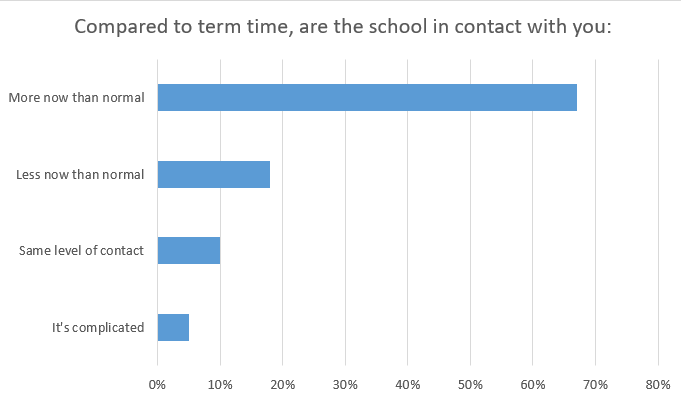
I conducted a couple of polls on social media 4 weeks into school closure, looking to find out whether contact with schools had increased or decreased since learning became remote for the vast majority of students. I asked this question to both SEND professionals and parents/carers of children with SEND, as 2 distinct groups (but not discriminating by sector and stage). 140 parents/carers answered; 101 SEND professionals.

Parents and carers of children with SEND:


SENDCOs and SEND professionals:

Full results are shows in the tables, but in a nutshell:

  • The most common response was that contact had increased since school closure (67% SEND professionals; 43% parents/carers)
  • SEND professionals believed in greater numbers that contact had increased, suggesting a difference in perception between themselves and parents/carers (67% – 43%).
  • 80%+ of parents and professionals acknowledged a difference now in the frequency of contact since school closure.

What kind of contact?

So what of this increased contact? Parents who left a comment on the poll talked of weekly phone calls, of schools using Twitter accounts and Google classrooms. Of work packs and Zoom calls. Now clearly these things won’t be needed in the same way when we go back to ‘normal’. But will we just go back to working with our pupils and leaving the parents out of the picture, as we’re so guilty of?

I don’t want to take a moral high ground here. I’ve frequently, during a busy week in which most of the things on my list remained incomplete, failed to take the time to inform parents of changes, let alone listen to parents and use their views to inform the work we do in school. Failing to use parents makes my work as a SENDCO less effective.

An opportunity for change

I’m convinced we can change school-parent relationships as a result of the current school closure. I’m convinced that creative approaches, with parents at the centre of them, will be needed if we’re to successfully transition students back into full-time schooling. I’m convinced that empowered parents, with an even better awareness of their child’s ability and attitude to learning and with better-developed relationships with school staff, won’t accept anything less than being a full part in provision.

The Lamb Report (2009) called for:

‘a radical recasting of the relationship between parents, schools and local authorities to ensure a clearer focus on the outcomes and life chances for children with SEN and disability’ (Lamb, 2009).

If the nation’s schools closing isn’t the catalyst for this radical recasting, I’m not sure what is. Contact three times per year? I strongly suspect this is no longer acceptable.

In the next blog: how to ensure effective parent-school partnership when schools reopen

References

Bartram, David. 2018. Great expectations: Leading an effective SEND strategy in school. Woodbridge: John Catt Educational Ltd.

Dale, Naomi. 2008. Working with families of children with special needs: Partnership and practice. London: Routledge.

Department for Education/Department of Health. 2015. Special educational needs and disability code of practice: 0-25 years. DFE-00205-2013.

Eleftherakis, Theodoros G., Kourkoutas, Elias, Vitalaki, Elena and Hart, Angie. 2015. Family-School-Professionals Partnerships: An Action Research Program to Enhance the Social, Emotional, and Academic Resilience of Children at Risk. Journal of Education and Learning. Volume 4, Number 3.

Gwernan-Jones, R., Moore, D. A., Garside, R., Richardson, M., Thompson-Coon, J., Rogers, M., Cooper, P., Stein, K. and Ford, T. 2015. ADHD, parent perspectives and parent–teacher relationships: grounds for conflict. British Journal of Special Education. Volume 42. Issue 3.

Kreider, Holly; Margaret, Caspe; Kennedy, Susan; Weiss, Heather. 2007. Family Involvement in Middle and High School Students’ Education. Involvement Makes a Diference: Evidence that Family Involvement Promotes School Success for Every Child of Every Age. Harvard Family Research Project. Volume 3.

Lamb, B. 2009. Lamb Inquiry Special Educational Needs and Parental Confidence. Annesley: DCSF Publications.

How to fix a broken inclusion system

In the first blogpost, I argued that the system of supporting children and young people with complex needs is broken. It punishes schools whose Headteachers see inclusion as their duty, rewarding those who put up barriers to inclusion. What would a fairer system look like? What incentives would need to exist for balance to be restored into the system?

Can schools be shamed?

A table of schools within one Local Authority was sent round to me last year, with each school’s number of EHCPs on roll. Of these non-selective, mainstream primaries, 7 schools had over 10 EHCPs; 1 school had 21. 16 schools had fewer than 5 EHCPs on roll; 1 school had 0. It is hard to argue a reason for such variation within 1 authority. Some schools are inclusive, many are not.

Amongst SENDCOs, the exclusive school gets a bad name. However, beyond this, there seems to be little impact on a school’s reputation. If the public knew more about a school’s level of inclusion, would change be more likely? Society has the potential to make moral decisions when a reputation depends on it. Bars will stop using plastic straws; supermarkets will stop throwing away unsold food; companies will turn their lights off at night-time. They do this because they care about the planet and humanity. And in some regard, because their positive actions get celebrated and their negative actions get shamed; in short, their reputation is at stake. Could this be applied to schools? What would happen if there was public celebration of a school’s level of inclusion? If prospective parents had an awareness of whether their local school fulfils its duty to educate local children, regardless of need, would more schools start ‘doing their bit’?

This is difficult of course. Some schools are quite content picking the educational cream of the crop – children who in some cases provide less complexity and who in many cases are more likely to get to age-related expectations. Likewise, some parents and carers are quite happy sending their child to a school where they know their child will sit alongside peers who are likely to present neurotypically. For these reasons, celebrating inclusion (and by definition, shaming schools who fail to be inclusive) is unlikely to be enough, and may only serve to further entrench the idea that some schools cater for students with SEND, while others don’t have to.

If publicising data around inclusion may only serve to further entrench these difficulties, what about providing financial incentives to being inclusive?

Could it actually pay to be inclusive?

A school can fight hard not to admit students with complex SEND; they receive neither shame nor consequence for taking such a stance. The school has no incentive, other than a moral one, to become more inclusive. Unless you cut its budgets. Every school receives an SEN notional budget based on factors relevant to its cohort, including deprivation in the local area, but not linked to the number of EHCPs or to the size of its SEN register. If this budget were boosted in schools that are inclusive in their practice and reduced in schools that are not, could this be enough to redress the inclusion imbalance in a local area?

It is not my argument here that neurotypical children should suffer because their school leaders are hesitant to serve the needs of children with SEND. However, the inclusive school needs and deserves the SEN notional budget more than the school that has fewer children with EHCPs. Those schools who are more inclined to accept children with more complex needs should be rewarded, not punished for doing so. I see no reason why this shouldn’t be at the expense of those who are less inclusive, through a recalculation of the following year’s SEN notional fund allocation. Take money away from schools who aren’t inclusive, in order to allow schools working inclusively to be properly funded to do so.

But if you’re financially rewarding inclusive schools, how do you measure inclusion?

Measuring inclusion

Inclusion cannot be measured according to the size of an SEN register. We have seen before that if you incentivise a large SEN register, schools are far more likely to load their register irrespective of need, having no incentive to reduce or to accept when children no longer need specialist support. Furthermore, if you count only the amount of EHCPs in a school, you are doing a disservice to those schools who are less desirable to parents. Parents of children with EHCPs can ensure that consultation paperwork is only sent to more desirable schools – this too is not of itself a fair measure of inclusion. If you only use exclusion rates or academic attainment of children with SEND as your measure, schools are given yet another incentive to err away from accepting children with the most complex needs.

The calculation for inclusion needs therefore to be broader than this. It could be an equation that factors in:

  • % of students on roll with EHCPs and the difference between this and your Local Authority average.
  • % of EHCP consultations responded to positively – i.e. saying that you are able to meet need (regardless of whether or not the child ends up on roll at the school)
  • % of children with an EHCP by the end of year 9, who remain on roll until the end of year 11 (removing the temptation for unofficial off-rolling)
  • Attendance and exclusion rates of children with SEND

The resulting score from this equation would see some schools scoring highly for their inclusive practice, while others drop down the inclusion league table, as schools that don’t do their bit for inclusion.

I’m heartened by the similar work that Mime (Making information Matter) has done, in conjunction with NASEN, to publish an Inclusion Index for Local Authorities. However, unless such statistics dial down to the individual school level, there will continue to be a feeling that some schools are doing their duty – in spite of the financial and academic-outcomes reasons not to – while others look the other way.

Reputation + OFSTED + budgets = change

If the resulting score were known locally, published by Local Authorities as part of the school application process and celebrated with an ‘inclusive schools’ Kitemark, change might be possible. If OFSTED considered it of relevance to their inspection, change would certainly be possible. If budgets were affected as a result of a school’s level of inclusion, change would be unavoidable.

Inclusion: the system is broken

The school system works best for schools who have no children with SEND on roll. Schools who aim for inclusion have greater budget struggles, a tougher time impressing on performance tables and as such greater difficulty getting to OFSTED Outstanding. There’s no equity. Society would largely agree that schools should be inclusive of the needs of children in their local area, irrespective of level of need. But what is the consequence when schools decide not to, putting up barriers to either not admit such pupils or to move them on: through official exclusions, unofficial off-rolling, early annual reviews of EHCPs or merely making the school environment unconducive to neurodivergent children, and therefore a less appealing choice for parents and carers? Could the system be changed so that consequence was felt? What would a system look like that actually incentivised schools to be more inclusive?

This image has an empty alt attribute; its file name is integration-3804350_960_720-1.jpg

The financial cost of being inclusive

Picture the inclusive school. It accepts many students with EHCPs onto their roll. It makes the adjustments to ensure they stay there throughout their school career. It learns about students’ needs, where students don’t already have an EHCP, and takes steps to ensure that statutory assessment for an EHCP can be undertaken. It makes reasonable adjustments to ensure successful outcomes wherever possible. Financially, it finds the first £6000 from its own SEN notional budget (More info on SEN notional budgets here, for the uninitiated) to pay for the provision listed. It receives high-needs funding but that is likely to cover only a fraction of what it costs to put in the resource required, perhaps a second adult in the classroom for that child or some other form of specialist support. It therefore has to dig further into its SEN notional fund, shrinking the pot for students at the SEN Support level. Every time the school accepts a child with an EHCP/successfully applies for an EHCP, its high-needs funding increases but this is outweighed by paying the first £6,000 from its SEN notional fund and making up the high-needs funding shortfall. Financially, it would have been better off being less inclusive.

This image has an empty alt attribute; its file name is 5dfbfe771b356f001cb4f52d-1.jpg

The results suffer

Keep picturing this inclusive school. As fewer children with SEND meet age-related expectations throughout the school system, the inclusive school is likely to have poorer results by many measures. It is therefore less likely to be given a judgement of Outstanding by OFSTED, for whom attainment data forms a not insignificant part of their judgement (see the inevitable correlation between outcomes and OFSTED judgements here). If your school is exceeding national attainment averages for students with SEND, you might have 40% at age-related expectations at the end of Key Stage 1, 30% at the end of Key Stage 2 and a Progress 8 score of -0.4 at the end of Key Stage 4. Rather than a pat on the back, try getting percentages like these through OFSTED; particularly important in a small school that might pride itself on being inclusive, and for whom the results of students with SEND could hit the performance data hard.

Better off financially being exclusive

Picture a school that is not inclusive. It tries hard to have a low number of EHCPs and is hesitant to apply for new ones. The parents of children with SEND go elsewhere, where their children’s needs will be better met. Those children are replaced by children who may not have need. The school’s SEN notional fund – which will be the same as the neighbouring school that has 20 children with EHCPs on roll – remains largely untouched. This school doesn’t need to find the first £6,000 of provision from their own budgets for each child with an EHCP, as the inclusive school does. Not ringfenced, the school can spend their SEN notional fund wherever they need to. The school’s academic results will, in many cases, be higher without the presence of children with complex SEND. This is especially relevant in primary schools, where the primary measure of success is still attainment rather than progress. Despite the focus on curriculum in the new OFSTED framework, first-hand evidence and anecdotal experiences tell me that your externally-reported data is the strongest tool, or greatest weakness, that a school has. The exclusive school is more likely to become/remain Outstanding than the school that works hard to meet its duty to children with SEND. With this attainment factor, alongside the financial incentives to find a way to close your school gates to children with need, universal inclusion within the mainstream school system will remain a fantasy.

In the next blog: how to fix the system