I’ve inherited SEND Registers where families had not been told anything about their being on the school SEND register, let alone been listened to or co-produced with.
I’ve worked hard to fulfil statutory duties as set out in the SEND Code of Practice (2015) – to inform parents, to agree provision, to involve parents in decision-making, and more besides.
I’d get quite good at discussing the ‘what’ – what interventions are in place, what teachers are doing in lessons, what opportunities we’re offering.
But I never focused enough on the why.
Why we do what we do
Some teaching and learning practices can feel strange to families. A school might have silent starts to lessons, have a hands-down questioning policy, and use exit tickets at the end of lessons.
A parent might be concerned that silent starts are about ‘zero tolerance’, that hands-down questioning is about catching pupils out and that exit tickets are about checking who was listening. And perhaps, when practiced poorly, those things can be true.
But when done well, they can be highly inclusive.
A silent start can support a potentially dysregulated pupil to have the calm, orderly and predictable start to the lesson that helps them to access the learning.
A hands-down questioning policy can ensure the teacher gets in-the-moment feedback about who is ready to move on and who might need some additional support. It can show pupils that the learning is for all of them.
An exit ticket can provide rich information to a teacher that informs their planning for the next lesson and even indicates what intervention support might be needed in advance of that next lesson.
Though a teacher may need to more to meet the needs of pupils, including in some cases individualised approaches, they might represent part of a teacher’s inclusive high-quality teaching practice.
Sharing our why
Every parent wants the best for their child. Every parent knows their child best. But most parents haven’t been teachers, and may not know why we do these things in classrooms. They’ll only know it, if we talk to them about it.
So, as school leaders, how much do we talk about our ‘why’? The examples above are about the classroom approaches of teachers, but the principle of narrating our ‘why’ is the same in other areas – on why we deploy our TAs in a certain way, why we’re offering (or indeed, not offering) certain opportunities at lunchtime, on how we prepare pupils for adulthood.
Narrating our ‘why’ needs not to be a done deal, of course. A particular approach might be well-intentioned but ultimately isn’t working for a pupil, and it’s only by listening to families that we get a rounded sense of what is or isn’t working. Just because something is well-intentioned, doesn’t mean it is destined for success. But parents understanding our ‘why’ is more likely to lead to the joint partnership working that so underpins effective SEND provision.
So, the next time you’re planning a coffee morning or other event for parents, consider not only how to tell them what support is in place, for them or for all pupils. Consider planning a session in which you can explain – and of course, take feedback on – your ‘why’.
The SENDCOs I come across have enormously challenging roles. Each day might have professionals to get hold of, pupils to regulate, colleagues to check in on and parents to get back to, let alone, forms to fill in and emails to reply to.
Maintaining a longer-term, strategic lens in this context is tricky. The sheer busyness of the role can prevent a SENDCO from being able to prioritise strategic leadership of SEND.
Overcoming the operational challenges
The difficulty of remaining strategic is a reflection of the size and complexity of the role, not a criticism of SENDCOs. In this context, the most successful SENDCOs I know are good at turning their strategic priorities into a series of ‘habits’, which they then sequence accordingly.
For example, that might mean something like the following:
Daily
Checking in with key pupils (or ensuring key colleagues are doing so)
Checking in with the inclusion team
Maintaining visibility around school, including within classrooms
Knowing which pupils with SEND are absent
Weekly
Checking pupil attendance and following up as appropriate
Learning walks (or similar) with a specific focus
Parent surgery slots
Pastoral meetings
Staff surgery slots
Half-termly
Observing and feeding back to trainee teachers
Identifying key pupils for keyworking, attendance monitoring, etc.
Meeting with leaders with specific responsibilities, to support their inclusive leadership (Head of KS2, Attendance Lead, Family Officer, Head of T&L, etc.)
Meeting with the reading/literacy/phonics lead to discuss the intervention offer and the progress of pupils within those interventions
Termly
Meeting with the Finance Business Manager
Observing and feeding back to TAs
Learning walks with several middle leaders (i.e. Heads of Department or Phase) and senior leaders, with actions agreed as follow-up
Pupil review meetings, including pupil and parent voice activities
Reviewing the progress of pupils within interventions and adapting provision accordingly
Observing and feeding back to Early Career Teachers
Meeting with the SEND Link Governor
A parent coffee morning
Aren’t I busy enough already?
The list above infers that SENDCOs are given adequate time to do the role, and that they can spend time away from the urgent, operational matters that can easily dominate each day. We know that this often isn’t true in reality.
So anyone looking at this list should, at best, be considering what needs to be on their own list – what are the ‘habits’ that relate to their strategic priorities, which will be unique to their context, and what is realistic in the time available?
They also need to consider the factors that might get these habits ‘done’, or factors that might otherwise help or hinder their impact – alignment with the school’s development plan, support from other senior colleagues, additional protected time, or sharing these habits with other key stakeholders.
The last thing a busy SENDCO needs is to add even more to their to do list. But breaking down our strategic priorities into a set of regular habits, and trying to ensure these habits become enacted in practice, is one step to ensuring the development of our provision over time.
Raise your hand if you think the national curriculum could be improved, so that it better serves our children and young people with SEND.
Raise your hand if you think statutory assessments could be reimagined, so that they allow more pupils with SEND to have a positive experience of assessment.
Raise your hand if you think we should judge schools in ways that incentivise inclusive practice.
I’ve asked over two thousand educators to raise their hand over the past month – teachers, SENDCOs, Headteachers and support staff. Each time, there’s been barely a hand that isn’t high in the air. The appetite for change is clearly there – change that can benefit all pupils, but perhaps particularly pupils with SEND.
These changes are already afoot, through the Curriculum and Assessment review – a year-long process of getting under the skin of our current system. We are currently identifying where changes need to be for 5- to 19-year-olds, in the curriculum and in relation to assessments.
However, in order to identify the changes that are needed and have the right impact, we need to hear the views and experiences of as many professionals as possible.
You can share your thoughts, views and experiences through our call for evidence by completing the online survey before it closes on 22nd November. You might like to download our easy read form (PDF), to help guide you through the online form. It features clear definitions and simplified questions so you can complete the sections most relevant to you.
What needs to change about statutory assessments in order to ensure equity for pupils with protected characteristics?
How much do vocational courses give pupils the skills they need to carry on studying? Should they be taken at the same time as GCSEs?
What changes might you make to the national curriculum?
Are there any skills or subjects that all learners need to get ready for life and work?
Don’t feel the need to be expert in all key stages and in all areas – complete only the questions you feel able to; use your own experiences as the best possible evidence you could provide.
This work is being led by Becky Francis, with a panel alongside her that I’m privileged to be a part of. And although all of us on the panel have our own views, experiences and answers to these questions, it’s insights from stakeholders across the country that will provide the richest possible feedback to inform the Review.
It’s insights from children and young people in our education system and their parents, organisations working in the sector and staff working in schools and colleges every day, that will indicate the direction of travel that is needed.
For all pupils, but particularly pupils with SEND
This Review is considering how the education system works for all pupils. And my own belief is that change can benefit all pupils. For me, however, it carries particular pertinence for many pupils with SEND.
How many children and young people with SEND in our education system are thriving in spite of some elements of that system, rather than because of it?
How many children and young people with SEND aren’t thriving at all within our education system, for reasons that directly/indirectly relate to curriculum, assessment and accountability measures?
If you also believe that change is needed, I ask you kindly to take some time to fill in the call for evidence, and to promote the call for evidence to your communities, your colleagues, parents and the young people you support.
Any and all contributions to and promotions of the call for evidence will help the panel truly understand what is working well, where improvements are needed and what new approaches might be possible.
Please don’t miss your opportunity to contribute to this important opportunity for change.
Gary Aubin is part of the panel of the Curriculum and Assessment Review panel. He leads Whole Education’s MAT SEND Leadership programme, is an independent SEND Consultant and wrote The Lone SENDCO.
Too many families have to fight when their children have Special Education Needs and Disabilities (SEND). They have to battle a system that seems not to have been built with their children in mind.
These fights take many forms. They might be about reasonable adjustment, about EHC Needs Assessments, about diagnostic assessment, about school placements.
And the consequences can be stark – needs not being met, progress faltering, engagement with education dropping, self-esteem decreasing.
The system – of education, let alone SEND – needs change. No parent needs me to tell them that. And many of these changes lie far outside of the scope of the review I’ve got the privilege to be involved in. Yet there is space and hope for change.
Covering curriculum, assessment, and the accountability measures by which schools are ranked, the review will produce key recommendations for the government. It is important that these recommendations keep the impact on pupils with SEND at its heart.
But in order to have the right impact, the voices of families and young people need to be heard. This is true universally, but perhaps it is especially true of those with SEND experience, many of whom feel so badly let down by our current system of education.
So, please, take the time if you are able to complete the call for evidence before 22nd November.
The potential for change
Though there are no easy solutions, it’s clear how improvements to curriculum and assessment might support many pupils with SEND.
A child with SEND may find it easier to manage the demands of school, where the curriculum is taught at a pace they can keep up.
A child with SEND may find it easier to manage the demands of school, where the curriculum feels relevant to the world around them and supports them through their transition to adult life.
A child with SEND may well find it easier to manage the demands of school, when assessments feel manageable and appropriate for them, and are inclusive in nature.
But in order to make recommendations that will help a child with SEND find it easier to manage the demands of school we need to hear your thoughts and views and your child’s experiences.
How to take part
You can take part and help your child take part or record your child’s views on their behalf through our call for evidence by:
We’d suggest using a copy of the PDF to help guide you through the online form. It features clear definitions and simplified questions so you can complete the sections most relevant to you.
It’s a lengthy document, but you need only complete questions you have an opinion on. Responding to even one question helps to shape the collective feedback, so that the panel fully understand the change that people are calling for.
Questions specifically focusing on the experience of those with protected characteristics, such as SEND are 6, 7, 8, 13, 17, 18, 22, 24, 33, 35 and 36.
Questions on primary school are 4-14.
Questions on secondary school are 15-30.
Questions on college and 16-19 education are 31-43.
Questions drawing out how the curriculum and assessment system prepare young people for adult life are 25, 26 29, 40, 42 and 43.
When thinking about your and your child’s experiences, please try to give specific examples and as much detail as you’re happy to provide, to help the panel truly understand what is working well, where improvements are needed and what new approaches might be possible.
Making changes to curriculum, assessment and accountability measures will not bring all the changes needed for our pupils with SEND. But it is an important opportunity to redress the balance. To make the changes needed to support pupils with SEND to succeed because of – and not in spite of – the education system around them.
Gary Aubin is an independent SEND Consultant working with Whole Education. His second book, The Parent’s Guide to SEND, is out early in 2025.
And let me be clear: the direction of that reform is inclusive mainstream.
Bridget Phillipson, Nov 7th 2024
I welcome this aim. It enacts families’ legal right to mainstream education. Without disrespecting the incredible work of the specialist sector, it can ease the very real pressure for special school places. It perhaps even represents the inclusive society many of us would hold as an ideal. But, clearly, it won’t just happen.
Many will remember the first time they read the hotly-anticipatedSEND and AP Improvement Plan, when it was published in 2022. As the new government have done, the previous government emphasised the need for mainstream schools to meet needs (the word ‘mainstream’ is used 82 times in that document). And while few disagreed with the desired aim, it felt like there were big gaps in outlining the steps needed to achieve this.
I welcome the news that Tom Rees, Christine Linehan and ‘leading neurodiversity experts – including those with lived experience’ will be advising the new Government on the changes required to make this work.
The challenge is considerable. Many changes are needed if this is to work. Here, I outline five of the changes that might be needed, to deliver on successfully inclusive mainstream schools.
Reimagining the wider system
Many schools know exactly what their pupils need, but are working in a system that disincentivises them from delivering it. This might relate to elements of the OFSTED framework, concerns from a Headteacher about their school’s Progress 8 score, or pressure to cover curriculum content at pace before the May exam season.
Meeting needs in mainstream is partly about ensuring schools are free to make more of those good decisions for the pupils in front of them – perhaps a pupil needs a greater focus on personal development, a different qualification offer, an approach to assessment that is more meaningful to them, or a different conception of curriculum breadth.
Steps in this direction from OFSTED and from the Curriculum and Assessment Review are welcome, and will I hope support schools to do even more of what they know their pupils need.
Developing expertise
I’ve got real hope for what the SENCO NPQ can do to support SEND leadership. But clearly, for a truly whole-school ownership our pupils with SEND, it requires the development of all staff.
There are all kinds of excellent trainings available through NASEN and their partners, under the Universal SEND Services contract. Thousands of colleagues have been undoubtedly upskilled by the resources and opportunities they provide.
That said, 88% of teachers say they need more help to support their learners with SEND, in a recent Teachertapp survey:
Source: Teachertapp, June ‘24
And when asked how they could better meet needs, while the number one request is more TA support, the next 3 requests from teachers – time to plan, time for training and advice to help me meet needs– suggest that more is needed.
What if every staff member was given a properly funded ‘SEND hour’ each week, as additional PPA? What if teaching loads/contact time could be reduced, so that staff can properly focus on further developing their inclusive practice? These are tricky things to resource, and tough in the context of a recruitment shortage, but it would go some way to recognising that staff can’t thrive without changes that recognise the additional SEND need in their classrooms.
With a dedicated hour of additional PPA for all staff, schools could develop their own plans for supporting and upskilling their workforce, so that each week, every colleague is engaged in those things that can take a bit more time within SEND – some co-planning time with the SENDCO, time to read and talk through a piece of specialist advice, time to visit a colleague with some expert practice.
Sharing expertise
I would propose that almost every mainstream school in the country has pupils on its roll who formerly would have been educated in a specialist setting. I’d also propose that opportunities for mainstream settings to learn from specialist settings have largely not kept pace with this change.
That said, special schools themselves frequently go over their own capacity and have their own increasingly complex pupil cohorts. What capacity do specialist settings have to share the best of what they do, to upskill and support their local mainstream schools?
If that capacity isn’t there currently, that’s not to say it couldn’t be. If special schools are properly resourced to support their local mainstream schools, providing the support and guidance that means more pupils can thrive in mainstream, how freeing that could be for the system.
And where mainstream settings have excellent models of inclusion, how are they supported and incentivised to exemplify their practice and to share generously, for the good of the wider system? This might be about local champions or regional hubs, to show other mainstream settings what their own approach could look like. It might be about some of the models of practice-sharing and leadership development developed by Whole Education, CST or Ambition Institute, for example.
It could be about local authorities facilitating networks of schools and SENDCOs, who meet regularly to share practice and move forward together, learning from each other’s provision in a spirit of positive cooperation. Whole Education also work in this space.
Investment
There is no shying away from this needing money. But the greater point is about spending money in the right way, spending it early, and spending it in ways that ensure the commitment to mainstream can be done well.
Think of all those mainstream settings who have taken charge of their changing cohort, by opening their own resourced provisions, for example. Typically, schools are given additional resource if they’re opening a resource provision alongside their local authority. What does this look like when schools are now ‘going alone’ with such provisions?
Where is the opportunity for schools to apply for capital investment to build or to re-purpose a building, through a SEND buildings ‘pot’, or to pay for their staff to receive additional specialist training?
This might start by ringfencing and topping up the SEN notional budget, so that more specialist needs are genuinely met in mainstream, without compromising what that child would have received in a specialist setting.
It might mean placing specifications on how some of the SEN notional budget must be used, including for training and supporting staff. It might mean ensuring schools publish how they’re using their SEN notional budget to upskill and support their own workforce, signed off by a Headteacher and Governors, and monitored through inspection.
Research
I’ve leaned heavily on research evidence to develop my own understanding of how settings might approach supporting pupils with SEND. Resources from the EEF, the CEEDAR Center in Florida and David Mitchell’s excellent book on the topic are some of my ‘go to’ resources. But there’s more we could do, surely. More research we could invest in, so that schools are supported to know what the research evidence suggests about SEND leadership, meeting a wide range of needs, creating the right learning environment or supporting positive learning behaviours, and more besides.
This list will no doubt have many omissions. But it may also provide hope around how inclusive mainstream schools can be not just the reality for some and the aim for many, but can become the reality for all.
Gary Aubin is an independent SEND Consultant working for Whole Education. He also sits on the Government’s Curriculum and Assessment Review panel and is the author of The Lone SENDCO.
When you walk into an inclusive classroom, you can often tell straightaway. It’s in the relationships, the communication, the learning environment. But these things (secure relationships, clear communication, etc.) benefit all pupils – so does that mean teaching pupils with SEND is ‘just good teaching’? Let me elaborate on why, for me, the answer is no.
Making teaching ‘the thing’
If we are looking to improve a wide range of outcomes for pupils with SEND, we should focus on high-quality teaching. From NASEN’s CEO, Annamarie Hassall MBE:
One of the most impactful experiences for learners with SEND is to have access to high quality, inclusive teaching.
(NASEN, Teacher Handbook: SEND, 2024)
If we are looking to understand what ‘high-quality teaching’ might mean for pupils with SEND, we know that it means many of the things that support all pupils anyway. From the EEF:
To a great extent, good teaching for pupils with SEND is good teaching for all.
(EEF, SEN in Mainstream guidance report, 2020)
Just good teaching?
Teaching any class of pupils can be a challenge. It needs us to communicate well, to understand our pupils’ starting points, to track progress constantly, to develop secure teacher-pupil relationships, to give feedback effectively, to nurture children’s social and emotional wellbeing, to motivate learners, and a hundred things besides.
Teaching in a way that meets the needs of pupils with a range of SEND can be really hard. It needs us to communicate well, to understand our pupils’ starting points, to track progress constantly, to develop secure teacher-pupil relationships, etc. (see previous paragraph).
So, it’s true that good teaching for pupils with SEND is built on many of the same principles and practices as good teaching for all. No pupil will be harmed by content that is taught clearly and communicated well, within a calm learning environment underpinned by consistent routines and relationships of trust.
Why ‘just’?
But here’s the rub for me – it’s nonsensical to suggest that good teaching needs a ‘just’ anywhere near it, like it just happens. Good teaching is really hard.
For classroom teachers, it takes resilience, reflection, a mindset of inclusion, a thick skin, excellent communication skills and the implementation of many of the approaches mentioned above. It also takes a good working understanding of your pupils and their needs, especially their SEND needs. To call this ‘just good teaching’ undervalues the skill and hard work required to be a consistently good teacher.
For school leaders, it takes the creation of a culture of ongoing improvement, the implementation of a well-sequenced curriculum, a targeted programme of ongoing support and CPD, insightful data collection, a strong understanding of a pupil cohort (including SEND needs), respectful and purposeful line management, and many things besides. School leadership is also not something we should devalue by suggesting that leaders work towards embedding a school culture of ‘just good teaching’.
So, pupils with SEND should be our starting point, not our after-thought. Get it right for those pupils and we’ll probably be getting it right for all. And getting it right is largely about good teaching. But let’s never call it ‘just’ – it deserves more credit than that.
Gary Aubin is the author of The Lone SENDCO, a handbook for busy SENDCOs, containing answers to over 300 questions.
I’ve met many frustrated SENDCOs. They spend a lot of time perfecting their ‘pupil profiles’, only for no one to ever read them, let alone enact the strategies written on them.
I’ve met many frustrated families. They co-produce an accurate and helpful pupil profile, but when they ask their child what support they received that day, the strategies on the pupil profile don’t seem to have been implemented.
I’ve met many frustrated teachers. They have an increasing number of pupils in their classes with SEND, and each of them have a pupil profile with at least 6 strategies on. And they teach 10 classes across the week.
And in the middle of it might be a frustrated child, whose needs aren’t consistently being met in class.
Communication of pupil-level strategies is a fundamental part of the SENDCO role and is an essential part of a whole-school approach. So what is the way forward, in terms of individualised strategies, so that all children can thrive?
Non-negotiables or useful ideas?
Some strategies are rightly non-negotiable. Consider these strategies, written about 3 different pupils:
Always sit this pupil on the left-hand side of the classroom (the pupil is deaf in one ear)
Ensure she is allowed to use her ear defenders (this autistic pupil has made great progress in her ability to self-regulate in the classroom)
Do not force them to contribute verbally (this student has a diagnosis of situational mutism)
Some strategies are the physical enactment of a disabled pupil’s protected characteristic – the reasonable adjustment that it would be immoral, not to mention unlawful, not to make.
Others strategies are useful ideas. Consider these strategies, written about 3 different pupils:
Print out the slides so the child has them on their desk (the pupil prefers to work independently through tasks and finds the literacy demands easier with printed slides)
Check in with this pupil before they begin their written work (the pupil lacks confidence as a writer and often struggles to get started with written tasks)
Sit the child next to a preferred peer (the pupil finds it hard to build and sustain friendships)
Now, don’t get me wrong – the child must be at the centre here. There are pupils for whom the second list should also be considered essential. However, in many cases, the second list should allow for teacher discretion within the implementation. In many cases, these should be ideas for consideration, rather than non-negotiables.
A teacher’s discretion
Print out the slides so the child has them on their desk
Imagine a year 10 science lesson, in which pupils are being taught to draw ray diagrams for lenses. Experience has taught this teacher that she should lead the learning carefully in such a lesson, breaking down the task into steps and modelling each step before students practice it themselves. She chooses not to provide printed slides, because she wants all eyes on her as she live models each step; she doesn’t want any pupil getting ahead with the content.
Check in with this pupil before they begin their written work
Imagine a year 6 teacher, who has 2 children with this strategy on their pupil profile. By the summer term, Child A has some great strategies for first-person creative writing, and within this type of lesson doesn’t require a check-in before they get started. Child B has told the class TA that they don’t like being singled out for extra help – in this case, a 1-1 check-in. In both these cases, the teacher has used their professional discretion not to implement everything on the pupil profile, and in this case to let pupils begin their written work independently.
The unintended consequence of a strategy-led approach
There are all kinds of reasons why a teacher can’t, and perhaps shouldn’t, be attempting to implement 6+ strategies for 5+ pupils in each lesson they teach.
Focusing on a fixed list of strategies can stop a teacher from being adaptive – it can stop them from noticing what a child needs, in the moment, that may not be written on a pupil profile.
Trying to plan for and implement 30+ strategies can impact significantly on workload, so that meeting pupils’ needs feels like an insurmountable extra to the already difficult job of teaching a class of 30.
And finally, overly-bespoke strategies can lead to stigma for those pupils who always seem to be receiving something different to their peers, building a sense in pupils that the standard classroom offer isn’t for them.
When teachers get it right
The best teachers I see do a few things well, in relation to the strategies they’ve been asked to implement for pupils with SEND.
They quickly get a sense of which strategies are non-negotiable, and they are consistent in how they implement them. They see other strategies as a menu of options, to come back to when pupils are starting a new unit of work, or to reflect on again if they have concerns about a child’s progress.
They build inclusion into everything they do, focusing on their lessons being ‘inclusive by design’. As a result, they don’t make children with SEND feel different. They don’t make pupils feel that their education requires something which is always additional to, or different from, the offer in place for their peers (problematic, I accept, in definitions we have of SEND in England).
They reflect on the progress of pupils with SEND in all that they do, and look beyond merely pupil profiles as part of this reflection – it becomes a key feature of line management meetings, professional development opportunities and ongoing discussions with families.
They have a mindset of inclusion.
When SENDCOs get it right
As a SENDCO or other senior leader, this might mean a few things:
Focusing on universal-level inclusive practices in every classroom, minimising the need for ‘additional to or different from’ in many cases;
Getting feedback from teachers about the strategies written on pupil profiles;
Aligning pupil profile strategies around a number of core teaching practices, wherever possible;
Building the strategies from pupil profiles into whole-school professional development.
This isn’t a magic bullet, clearly. The increasing numbers of pupils with SEND in mainstream schools can make whole-school leadership of SEND particularly challenging.
That said, the most successful schools I know don’t overwhelm their staff with strategies. They show teachers that meeting the needs of pupils with SEND is not only a core function of teachers, but actually – while not being easy – is within the core skillset of teachers in many cases. It’s only by enabling this level of teacher empowerment that schools can ensure a whole-school commitment to inclusive practice.
It’s a popular refrain that SENDCOs should be on SLT. So, in order to ensure effective leadership of SEND, should schools be placing their SENDCO on SLT? I wonder if that’s not only over-simplistic as a solution – it may even be that we’re asking the wrong question in the first place.
SLT would not have helped me
There’s an obvious reason why a SENDCO should be a part of their school’s SLT – greater influence across the school, which should be good for pupils with SEND.
That said, it’s not always straightforward. When I became a secondary SENDCO, it was only my second leadership role in school, having previously been a Head of Year. I was unqualified in SEND, inexperienced in leadership and encountering an impostor syndrome that will be familiar to many.
I had a great deal to learn all at once. How to work in partnership with parents, how to track and record the progress of pupils, what strategies I might recommend to colleagues and how I might ensure they’re being enacted in practice – let alone the statutory and paperwork demands of the role.
Placing me on SLT would have been the worst thing for the school to do. I didn’t have enough experience as a middle leader, let alone the ability to contribute usefully at the top table of school leadership. I had enough to learn as a new SENDCO, without being given the potential trappings of school senior leadership – line managing curriculum areas, multiple duties per day and support for whole-school initiatives.
For many schools, a SENDCO’s elevation to SLT is straightforward and effective. I won’t argue with any Head looking to take such a step. But it’s also worth considering why this is sometimes not quite the right way to think about it.
The current picture
Research in 2020 found that around 2 in 3 primary SENDCOs and just 1 in 3 secondary SENDCOs sit on their school’s Senior Leadership Team (Boddison et al, 2020). And these schools aren’t breaking any rules in this regard. The SEND Code of Practice (DfE, 2015) recommends such practice, but also allows schools to make their own judgement in this area:
6.87 The SENCO has an important role to play with the headteacher and governing body, in determining the strategic development of SEN policy and provision in the school. They will be most effective in that role if they are part of the school leadership team
The SEND and AP Improvement Plan (DfE, 2023) doesn’t commit to any strengthening of the wording here, though it describes effective SENDCOs as those who are ‘whole-school, senior and strategic’. It uses these words in relation to the introduction of the SENCO NPQ, the new statutory qualification for SEND leadership in mainstream schools.
A quick look at some of the ‘Learn How to’ statements in the SENCO NPQ echo the sentiment of ‘whole-school, senior and strategic’:
1.a Working with other leaders to develop, implement and monitor the effects of school policies
3.c Recognising where issues with teaching or curriculum quality may manifest as SEND and working with other leaders to address these issues swiftly
5.n With other senior leaders, providing a safe and open forum to debrief following serious behaviour incidents
It’s clearly only from a position of seniority that these goals can be meaningfully achieved.
Ask not ‘should my SENDCO be on SLT’; ask ‘who should my SENDCO be?’
That said, the question, as we ask it, may be the wrong way round. It’s not necessarily about asking ‘should we place our SENDCO on SLT?’, but it may be a much more fundamental question – ‘which of our senior leaders is best-placed to lead SEND?’ It becomes about schools asking ‘which of our leaders has the ability to be whole-school, senior and strategic in relation to SEND?’
In other words, to return to my experience of becoming a SENDCO, the learning is not that I should have been catapulted to SLT, it’s rather that someone else might have been better placed to be SENDCO in the first place.
When I started as a SENDCO, it was my first Head of Department role. So how did I approach it? I ran a department. I made sure that those within my department were supported to function well. I worked closely with the teaching assistants and others who made up my ‘Inclusion Department’. I took responsibility for developing the offer of interventions that the department ran, and developed our work partnering with families. I told my line manager proudly whenever I thought I was running the department well.
Was I whole-school? No. Was a senior? Not really. Was I strategic? On occasion, though my newness to leadership made this inconsistent.
Which of my senior leaders is best-placed to be my SENDCO?
There are inherent dangers in making a busy senior leader a SENDCO. If a Deputy Headteacher already has vast areas of responsibility, will it be useful to add the significant responsibility of SEND to this list, or might SEND coordination get lost among their other tasks?
This moves me to think of the safeguarding model in many schools. Frequently in schools, a Deputy Head is the Designated Safeguarding Lead. That doesn’t mean they carry out every function in relation to safeguarding – these might be done by a Safeguarding Officer, a Welfare Lead or a Head of Year – but the buck stops with them as a senior leader, as of course it should.
What might such a model look like within SEND? It might mean a Deputy Head becoming the SENDCO, giving the role a seniority and delivering advocacy for pupils with SEND in all school leadership decisions. It means the buck stopping with a leader who by definition should be whole-school, senior and strategic.
It might require some creativity about roles that support this senior SENDCO – a SEND Teaching and Learning Lead, a SEND Operational Lead, a Statutory Provision Coordinator, a SEND Assessment lead, a Head of SEMH provision or a Family Liaison Worker based in the Inclusion Department, for example.
Sometimes, enhancing SEND leadership will be straightforward. It might involve the easy promotion of a SENDCO, who is ready and able to make the jump to senior leadership. But sometimes it won’t be that easy. Either way, it’s imperative that schools find ways to ensure genuine, informed and effective leadership of SEND at a senior level, so that the needs of pupils with SEND run through all school leadership decisions.
When it comes to getting classroom teaching right for pupils with SEND, it isn’t always about funding. It isn’t always about having years and years of specialist SEND training. It’s about the flex.
Consistent in your principles; flexible in your practices
One of the best INSET sessions I ever attended was by Rob Long. I’ve no idea what he’s doing now, but I remember him talking about schools being ‘consistent in their principles; flexible in their practices’. I was a Head of Year at the time and this advice influenced my pastoral work. It then went on to influence my work as a SENDCO.
In SEND, we call this reasonable adjustments of course. We might associate this term with legal rights, protected characteristics, classroom strategies. But in practice as a classroom teacher or TA, it’s one of the hardest things to get right – how do I maintain high expectations for all, yet make exceptions for some? How can I create a classroom that is fair, when I’m treating pupils differently?
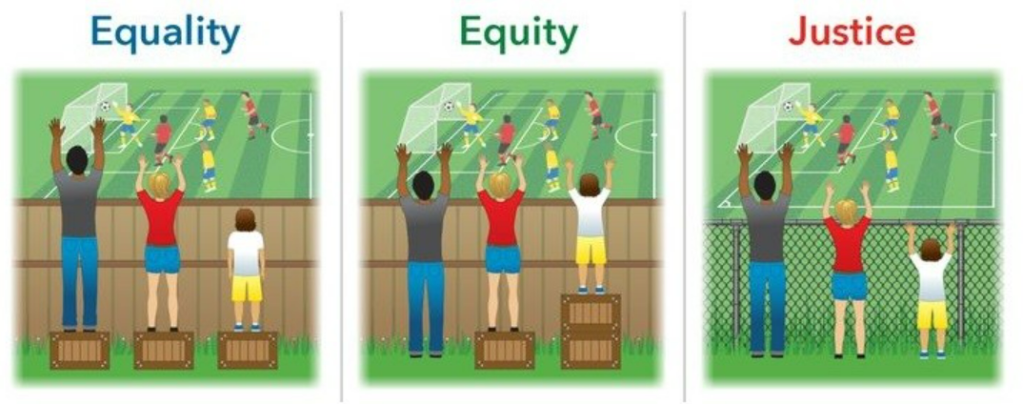
Which leads us to an image like this, often used in CPD around SEND:
The point of this image for teachers and TAs is 2-fold of course:
That it’s okay to provide different supports for pupils if it increases their access;
That if we can deliver lessons in a way that ensures individual support arrangements are not required, removing the barrier in the first place, that is ultimately ‘inclusive by design’.
In short, that we have flex in what we do.
Putting the ‘flex’ into our teaching
For those new to the profession in particular, there can be a steep learning curve here. If my objective is that pupils enter the classroom in silence, begin their work independently and share their answers in full spoken sentences, what might that look like for a child with ADHD, MLD and SLCN respectively*?
It starts with the principle above. If what I can provide for all pupils reduces the need for individual adaptations (justice, in the image above), perfect. If some individual adaptations allow all pupils to meet teacher expectations (equity, in the image above), great.
What might those individual adaptations look like? Let’s take the 3 examples above: silent entry, starting work independently and giving full sentence spoken answers. What might flex look like in these contexts?
Silent entry – a silent entry to the classroom will be tricky for certain pupils, but it might be made easier when the teacher checks in with that child before they enter, gives them a specific job to do when they enter the classroom and/or tells them they will be checking in with them individually, once the class are sat down.
Starting work independently – this will be tricky for certain pupils, but it might be made easier when single-step instructions are clear on the board, when the work increases in difficulty as pupils complete it (i.e. no one looks at Q1 and sees impossibility) and when prompts are provided (knowledge organisers, etc.) to support pupils if they get stuck.
Sharing an answer in a full spoken sentence – this will be tricky for certain pupils, but it might be made easier when the pupil rehearses their answer with a partner, writes it in a sentence or sees/hears a model answer first.
These specific supports won’t work for all pupils of course, but they are examples of a teacher offering flexibility, based on an understanding of a pupil’s individual strengths and needs.
Applying ‘the flex’ to behaviour
The same principle applies for promoting positive learning behaviours. In all the best schools I’ve worked in, the positive behaviour of pupils is supported by a consistent, explicit and well-articulated system. But it wasn’t a system that could work without flex.
Consider some common approaches to behaviour taken in schools. Generally in schools, pupils are expected to move calmly in corridors and to focus on teacher instruction in class. That’s an appropriate aspiration for all pupils, and not one we should merely abandon when pupils are on a SEND register. However, in our equality/equity/justice model, that consistent principle requires flexible practice. What might flex look like here?
Moving calmly in corridors – this will be tricky for certain pupils, but it might be made easier when adjustments are in place for some pupils – staggered exits from class, additional supervision at certain times in the day and the explicit teaching of expected behaviours.
Focusing on teacher instruction in class – this will be tricky for certain pupils, but we can set more pupils up for success if we understand what motivates and supports them to succeed – perhaps through showing a pupil the progress they are making, through an intelligent seating plan and through teacher instruction that uses pause, pace, repetition and questioning appropriately.
There are countless examples of what reasonable adjustment in classrooms can look like (books by Natalie Packer and Sara Alston are full of many great examples), but these can never account for every classroom scenario. The point for teachers is the flex.
With a mindset of flex, we can continue to aim high for all, but make sure we are taking all pupils with us. We can create a classroom that is not merely equal, and not only equitable, but provides access to a meaningful education for all pupils.
*It’s also about managing the value of the labels we attach to certain children. A child’s label of ADHD/MLD/SLCN might be a useful shortcut – and might be essential knowledge for all staff to have – but it will never be sufficient on its own.
Gary Aubin is author of The Lone SENDCO, a handbook for SENDCOs of over 300 questions and answers.
The SENDCO role in a mainstream school is invaluable, especially when supporting pupils with complex needs. External specialists can be equally as invaluable.
Are there times though when the presence of a specialist – the SENDCO, an Educational Psychologist – can delay teachers and TAs from making good decisions for pupils? In relation to the use of specialists within SEND, care must be taken to ensure colleagues are supported but not disempowered.
The importance of a referral
I’ve had many times in my career when I’ve been called in to offer expertise, whether as a SENDCO or when working across a MAT.
Seeking support should be encouraged. The earlier a colleague flags a concern, the earlier we can arrange intervention, informed by early identification. The problem though is with this idea that the expert carries a magic wand. It’s the magic wand approach that I feel needs addressing.
Delay delay delay
Think of a child who is struggling in their year 8 class. A teacher raises a concern to the SENDCO. The SENDCO gathers the information they need to make a referral to their local EP service. The external referral is seen and a date is arranged for the EP to come in and meet the child. The visit goes well and a report follows. The SENDCO arranges to meet the teacher who made the initial referral and supports them to implement the recommendations.
Even if that process goes smoothly, the process I describe above might take 3 months. For many overwhelmed SENDCOs and LA services, it might be far longer. But at least we’re now giving some good advice guy to the teacher who requested support.
The recommendations
Look at a list of recommendations sent by a really excellent Educational Psychologist, for a boy in Upper Key Stage 2 (anonymised):
Continued close liaison between home and school to support (pupil’s) emotional needs and ensure consistent transference of strategies
Further exploration and intervention to support his reasoning skills
Continued support and intervention to ‘catch up’ on his numeracy skills and literacy skills, especially his writing/recording skills
Access to a social-emotional learning curriculum, for example an individualised emotional literacy programme such as ELSA
Availability of a significant, consistent adult to deliver and review interventions and to prompt their use in class and in other contexts as appropriate
This is an excellent list. It has accurately captured his difficulties and suggested appropriate responses. But is there anything there that the school couldn’t have concluded themselves, if given the time and space to formulate such a plan? Is there anything in there worth waiting 3 months for?
Using our EPs differently
This blog isn’t looking to criticise Educational Psychologists, or any external specialist colleague working with young people with SEND. In every school I’ve worked in, I’ve ensured we have a budget to purchase additional EP days, such is the value of their partnership and their importance in the SEND system.
But we need to appreciate our own expertise as educationalists. Teachers and TAs need to feel they can notice what a child needs (or no longer needs) in a classroom and adapt their support accordingly. Similarly, SENDCOs need to feel skilled enough to quickly identify a challenge for a child, working with the family and young person at all times, and plan a response accordingly.
This approach will allow us to use our EPs in a way that provides greater capacity to drive outcomes for all pupils, especially our pupils with SEND. By valuing our own expertise, we can use EPs to share evidence-informed interventions, to deliver staff training, to audit our provision or to supervise and guide SENDCOs. We can use them to provide surgeries for staff, advice for parents and guidance to principals.
Intelligent trial and error
Getting it right for pupils doesn’t suddenly become easy – we’re still not possessing a magic wand – but it relies on our ability to implement ‘intelligent trial and error’; the ability to take the information we have, to try the most appropriate response, and to monitor its impact. What in SEND we often call the ‘assess-plan-do-review’ cycle.
Our ability to make informed and accurate decisions may come from:
What has worked for this pupil before, and which we need to try again;
What has worked for other pupils, and may work for this pupil;
What the evidence shows has worked for other pupils (and other similar pupils, where possible), and may work for this pupil;
What an external specialist recommends.
To talk of ‘error’ may sound flippant, especially to the families of children with SEND. No colleague ever wants their practice to be strewn with errors. The presence of specialist colleagues – whether an in-school SENDCO or an external Educational Psychologist – can help to reduce these errors, but it must never prevent teachers and TAs from reflecting on their own practice and making changes accordingly, in a timely manner, without always seeking external guidance.
It’s this ongoing cycle of reflection and amendment, from colleagues who reflect on their practice constantly, that will ultimately lead to better outcomes for pupils.












 SEND Matters