I’ve read a number of draft Inclusion Strategies in recent weeks. These five thoughts represent the best of what I’ve seen, as well as a few things worth avoiding.
Expectations from the Department for Education
The Department for Education’s advice was published before the summer. It describes a 5-step process…
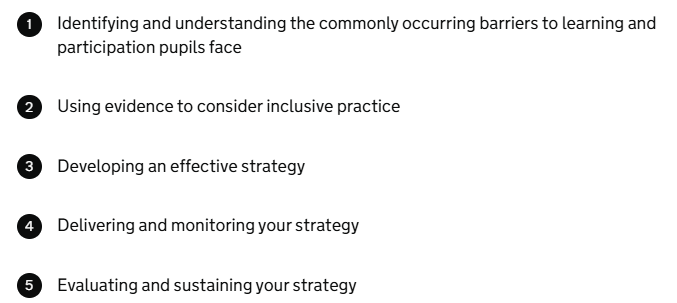
…based on 7 ‘principles of inclusion’:
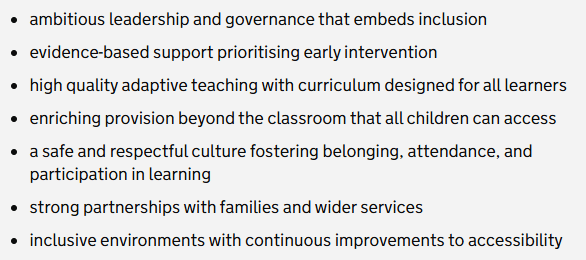
While there’s no need to repeat what’s on the guidance (which you can find in full here), the drafts I’ve seen lead me to these 5 thoughts…
- This is a public document
Some things belong on a school improvement plan for internal use, rather than a public-facing website. If a school is concerned that the quality of teaching for pupils with SEND is inconsistent, it might not want to say so publicly. Rather than stating that ‘teaching is inconsistent’, a school might state that it ‘wishes to further support teachers to understand and meet the needs of children with SEND’. This isn’t lying – and it ultimately will lead to the same work – but it treats a delicate issue delicately.
And clearly, anything that publicly criticises parents/levels of parental engagement would be unhelpful on many levels.
2. It’s not only a desk exercise
Some schools can approach this as a desk exercise – fill in the template, make sure it’s compliant and get it uploaded. This is clearly not the intention; it also misses an opportunity.
Schools should be finding accessible ways for a range of stakeholders to answer some version of the question:
‘We want to make our school even more inclusive. How do you think we could do so?’
In this spirit, it’s an exercise that galvanises, that engages and that listens. It involves pupils, staff, families and potentially others. Though it will become a desk exercise at some stage, a good level of consultation needs to precede it, for this process to catalyse a school further around the importance of inclusive practice.
3. ‘What are the barriers to our staff meeting these needs?’
This, for me, is the way to think about the Inclusive Mainstream Fund (and therefore the Inclusion Strategy). It’s not about criticising staff. And it’s not about a lack of desire to get it right. But it’s a recognition that delivering inclusive lessons can be incredibly challenging, and that pupils’ needs are not the problem.
Rather than changing the level of need, it’s about acknowledging what the barriers are to staff meeting needs – the need to replan schemes of work? Features of the classroom environment? Understanding of great practice for a given type of need? Some specialist training?
If so, what might help staff to overcome that barrier – release time to co-plan? Purchasing resources that support inclusive environments? Release time to visit special schools or strengthen links with AP settings? Greater access to external specialists or undertaking training courses?
Understanding staff barriers to inclusive practice, and committing to support and address them, can be a key part of a successful Inclusion Strategy.
4. Clearly allocate funds to activities
It’s true that leadership time costs money. If leaders are conducting learning walks, that’s an attributable cost.
And it’s true that an Inclusion Strategy should have current practice as its foundation in many cases.
But if the Inclusion Strategy is merely a way to record activities you’re doing anyway, it’s surely a missed opportunity.
If learning walk cycles (with accompanying coaching, training, feedback, etc.) happen anyway, how might investing in this process further increase its impact – through those leaders working more closely with external specialists? Through providing release time for leaders to see inclusive practice in other settings, and then use that learning within their own learning walk cycles? Through teachers having opportunities to work more closely with specialists? Through a new teacher having release time to shadow a more experienced colleague?
Using a small amount of additional resource to tighten and improve existing practices and processes feels like highly appropriate here.
5. Lean into the EEF’s Guide to Inclusive Teaching
This EEF guide is heavily referenced within the DfE template, and therefore worth taking notice of. It takes the EEF’s evidence base, from a range of Evidence Reviews and elements of their Teaching and Learning Toolkit, and promotes 5 universal-level teaching approaches and 4 elements of additional support.
The Guide also provides an opportunity to ensure that the work outlined in the Inclusion Strategy remains squarely about many of the inclusion principles outlined above – ambitious leadership, evidence-based support, high-quality adaptive teaching and inclusive environments, for example.
Schools might approach their Inclusion Strategy as a compliance task. Of the many, many elements of compliance that school leaders need to think about, this is perhaps one of the easier ones.
But it’s also an opportunity not to be missed. An opportunity to cohere a school community around inclusion. To leave no one in any doubt that inclusive practice is key, that it deserves investment, and that as a strategic priority it features strongly in the minds of every leader.
Gary Aubin is author of The Lone SENDCO, co-author of The Parent’s Guide to SEND. His latest book is The SENCO as Leader, a practice guide to the SENCO NPQ.