
I’ve never met a parent who doesn’t want the best for their child.
I’ve never met a teacher who doesn’t want the best for their pupils.
So, if we universally want the best for the children and young people in our care, why is there so much dissatisfaction with what’s taking place in schools? Perhaps it comes from a disagreement over whose ‘best’ we’re looking at.
A growing unhappiness
A Browne Jacobson survey (2024) found that the majority of school leaders reported an increase in parental complaints, with ‘support for pupils with special educational needs’ being the most prevalent topic of complaint. An NAHT survey of school leaders found this increase to be sustained over several years. There seems little doubt that many parents are unhappy with the provision their children receive when they have SEND.
Where our aims align
The 2024 Parentkind Survey asked parents ‘How important do you think it is that your child’s school curriculum focuses on the following?’. Of the answers given by parents, these are their top 5:
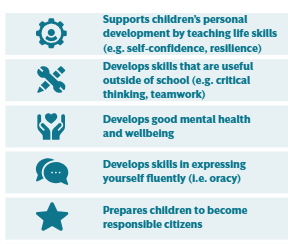
While educators may not answer the question in quite the same way, the teachers, TAs and school leaders I know would all be happy to accept the vital importance of what parents are asking for here – that children navigate the world confidently, deal with a range of situations well, are happy in themselves, communicate well and bring a bit of good to the world.
If those answers provide evidence that educators broadly align with what parents want, we could look to the Headteacher Standards to see evidence that parents broadly align with what school leaders aspire to:

I don’t know any parents who would disagree with these statements around what Headteachers are expected to prioritise.
Where it’s not that simple
Many parents, and many school staff, will know that this isn’t as simple as I suggest.
A school doing a great job will work hard to fulfil its statutory imperatives, to maintain a high pupil attendance and to ensure its pupils leave with the best exam results possible. They would be right to argue that they have pupils’ best interests at heart when they do all these things and more.
That doesn’t mean it always matches a parent’s priorities. A parent may very understandably not be able to see past their own family’s financial worries, work pressures or health concerns. While many schools talk proudly of supporting the whole child, few could claim to take quite the holistic view that a parent does of their child.
Why this matters
Of course, we need to put the child at the centre. By working together in a spirit of positive partnership, the child’s needs guide our work in a way that is only positive.
However, it’s over-simplistic to assume that, when we all put the child at the centre, things are straightforward. It’s easy to assume that a shared definition of ‘what’s best for the child’ can exist, when both parents and school colleagues might have different answers as to what is best in different areas for a child – should they take 8 GCSEs, or 9? Do they deserve to lose their breaktime for something that happened? Shall we reduce TA support in the afternoons? Shall we make the school trip mandatory?
Clearly, open dialogue and respect for each other’s views get us a long way here. A spirit of coproduction – on both sides – helps us to keep the child at the centre. But it’s perhaps only when we understand that what matters to each of us is a bit different, that we can achieve the empathy that this relationship deserves.
Gary Aubin and Stephen Hull have co-written The Parent’s Guide to SEND: Supporting your child with additional needs at home, school and beyond.
Find a one-pager with questions to ask when your child is transitioning to a new school, here.
References
School leaders survey findings – Spring 2024
The National Parent Survey 2024
https://www.gov.uk/government/publications/national-standards-of-excellence-for-headteachers

